
Nano Masters AI Oil & Gas Downstream
Nano Masters AI Oil & Gas Downstream is a technology-focused company that applies artificial intelligence and advanced analytics to downstream operations, helping refineries and petrochemical facilities optimize production, improve asset reliability, enhance supply chain and trading decisions, and strengthen safety and compliance.
About Nano Masters AI Oil & Gas Downstream
Nano Masters AI Oil & Gas Downstream is a technology-focused company serving downstream energy and petrochemicals with artificial intelligence, advanced analytics, and decision support. The company’s mission is to turn operational data into measurable improvements in margin, reliability, and safety across complex, high-throughput industrial sites. Downstream operations generate massive volumes of time-series, laboratory, maintenance, inspection, and commercial data, but value is often trapped in siloed systems and inconsistent workflows. Nano Masters AI Oil & Gas Downstream unifies these datasets and applies models that can detect early anomalies, recommend operating moves, and forecast constraints before they become costly events. Across refineries and petrochemical facilities, the company focuses on practical use cases: production optimization, energy and yield improvement, predictive maintenance, turnaround and integrity planning, and supply chain and trading decision support. The result is faster decisions with clearer trade-offs—balancing throughput, product quality, emissions, and risk. Safety and compliance are treated as first-class outcomes. The platform and services emphasize auditability, governance, and monitoring to help teams operationalize analytics in regulated environments, reduce process-safety risk, and maintain consistent performance across shifts and sites. With a large workforce and enterprise operating model, Nano Masters AI Oil & Gas Downstream is positioned to scale deployments across multiple assets, standardize best practices, and support continuous improvement programs over time.
What we offer
AI-enabled solutions for downstream operations, including real-time process optimization, advanced process control (APC) augmentation, predictive maintenance and reliability analytics, asset performance management, energy and emissions analytics, supply chain planning and optimization, trading and margin analytics, and safety/compliance monitoring with governed reporting and model oversight.

Who we serve
Primary customers include integrated oil & gas companies, refinery operators, petrochemical manufacturers, and downstream supply/logistics organizations. Target users span operations (console and field), process engineering, reliability and maintenance, planning and scheduling, commercial/trading, and HSE/compliance teams seeking margin uplift, fewer unplanned outages, and stronger operational discipline.

Inside the business
Downstream performance depends on thousands of daily micro-decisions—setpoints, unit constraints, maintenance priorities, blend choices, and shipment timing. Nano Masters AI Oil & Gas Downstream supports these decisions by connecting plant data to models and workflows that translate analytics into actions.
Operating model
The company operates through a combination of software delivery and domain-led services. It typically starts with data connectivity and governance, then delivers prioritized use cases in short iterations, validating value with site SMEs. Deployments are scaled through standardized templates, model monitoring, MLOps practices, and change-management playbooks that embed recommendations into operator, engineer, planner, and reliability workflows.
Market dynamics
Downstream operators face volatile crude/product differentials, tightening environmental rules, aging assets, and pressure to reduce energy intensity and emissions. At the same time, digital maturity varies widely across sites, and integration with legacy historians and planning tools remains a constraint. AI adoption is accelerating where solutions are explainable, auditable, and tied to measurable economic outcomes.
What changed recently (fictional)
Nano Masters AI Oil & Gas Downstream has expanded its downstream focus to include stronger supply chain and trading decision support alongside core refinery and petrochemical optimization. It has also emphasized model governance and compliance-ready analytics to meet stricter audit and reporting expectations across regulated operations.
Key performance metrics (KPIs)
These KPIs reflect what leaders typically track in Integrated Oil & Gas. Each metric connects to decisions that drive outcomes.
Decision scenarios (what leaders actually face)
The scenarios below are written to resemble realistic situations in Integrated Oil & Gas. They’re designed for practice, discussion, and evaluation — where context, trade-offs, and escalation matter.
A refinery must decide whether to switch to a discounted crude that may increase fouling risk and shift product yields while product cracks are changing weekly.
What this scenario reveals
How the organization quantifies risk-adjusted margin, integrates reliability constraints into planning, and uses analytics to manage uncertainty.
An ML model flags early-stage vibration and temperature drift on a critical compressor while the site is running near capacity to meet contractual shipments.
What this scenario reveals
Whether teams trust leading indicators, how they balance short-term production against long-term reliability, and how well decision workflows are operationalized.
Common failure points (and why they happen)
Downstream AI programs often fail not because models are inaccurate, but because data, workflows, and accountability are not designed for production operations. The following are common failure points that limit value realization.
Siloed data and weak governance
Historians, LIMS, CMMS, and planning systems are disconnected or inconsistently tagged, making it hard to build reliable features and maintain traceability for audits.
Model results not embedded in daily work
Insights arrive as dashboards or emails without clear owners, thresholds, or actions; operators and engineers revert to established routines under time pressure.
Lack of explainability and trust
If recommendations cannot be explained in process terms or validated against constraints, teams will ignore them—especially in safety-critical environments.
No lifecycle monitoring and drift control
Assets, catalysts, feedstocks, and sensors change; without MLOps, recalibration, and performance monitoring, models degrade and quietly stop delivering value.
Readiness & evaluation (fictional internal practice)
Readiness for AI in downstream operations is about more than data availability. It requires stable instrumentation, governed data pipelines, clear decision rights, and a path to operational adoption across shifts and functions.
How readiness is checked
Assess readiness through a structured review of data sources (historian/LIMS/CMMS/planning), tag quality and context, cybersecurity and access controls, existing KPIs and decision cadences, and the ability to implement recommendations (control limits, procedures, and maintenance workflows). Validate with a short pilot that includes value tracking and user adoption metrics.
What “good” looks like
Good readiness looks like: reliable and contextualized time-series and event data; consistent asset hierarchy; defined constraints and operating envelopes; clear owners for each decision; integration points to operational tools; and governance for model approval, auditability, and ongoing monitoring.
Example readiness signals
Example signals include: stable sensor uptime and calibration practices; a maintained CMMS with failure codes; documented operating procedures and constraints; cross-functional planning meetings with measurable outcomes; and leadership sponsorship tied to margin, reliability, and HSE targets.
Company images
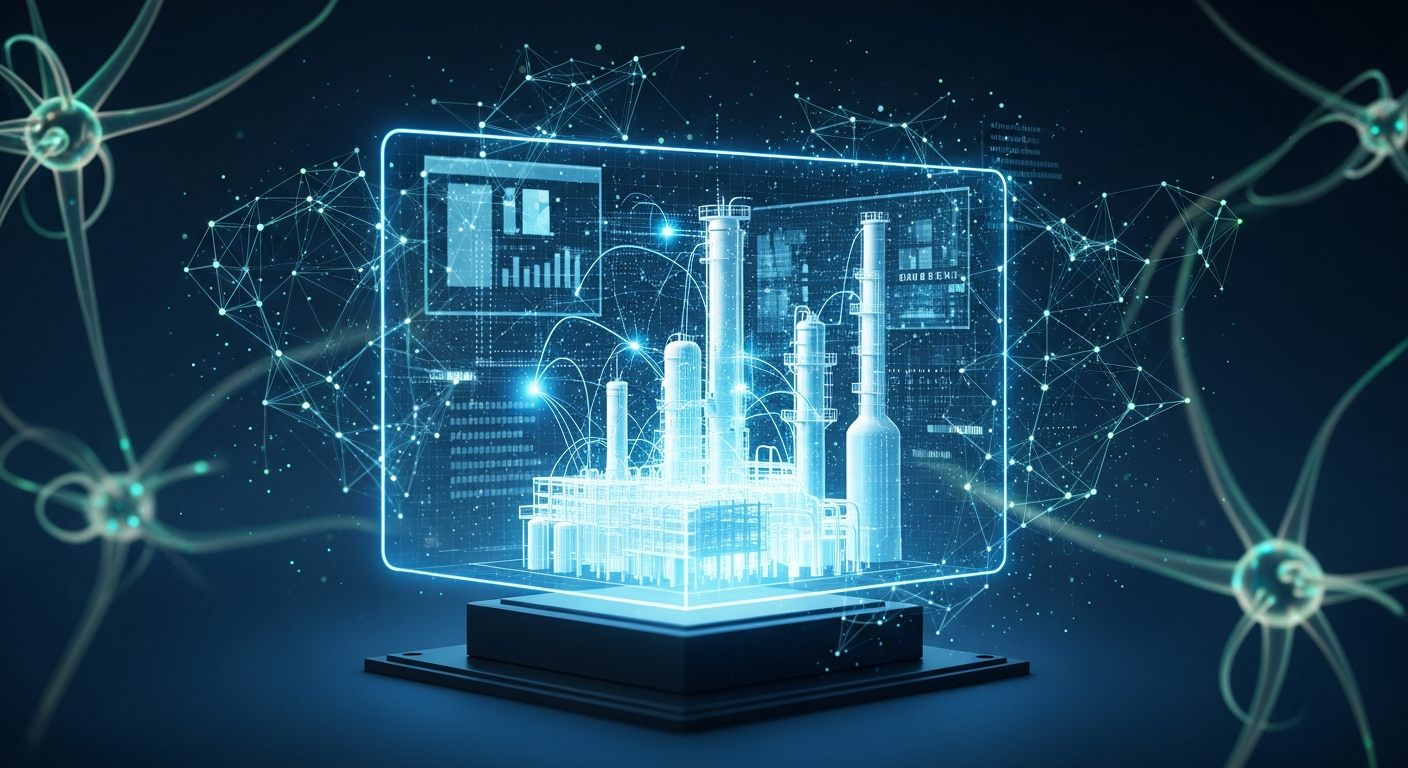
Visual context for learning (fictional, AI-generated). Three views help learners anchor decisions in a believable setting.


FAQ
Short answers to common questions related to Integrated Oil & Gas operations and decision readiness.
What does Nano Masters AI Oil & Gas Downstream do?
It applies AI and advanced analytics to downstream operations to improve production optimization, asset reliability, supply chain and trading decisions, and safety/compliance performance.
Who are the typical users of the platform?
Operators, process engineers, planners and schedulers, reliability and maintenance teams, and HSE/compliance stakeholders across refineries and petrochemical facilities.
What kind of outcomes can customers expect?
Common outcomes include margin uplift, reduced unplanned downtime, improved energy efficiency, higher on-spec production, better maintenance prioritization, and stronger audit-ready compliance reporting.
How is AI deployed safely in a refinery environment?
By using governed data pipelines, explainable recommendations aligned to operating constraints, role-based access controls, and continuous model monitoring with clear owners and procedures for action.
Contact & information
Website: https://nanomasters.ai/blueprint-company/nano-masters-ai-oil-gas-downstream
Location: United States
Industry: Integrated Oil & Gas